AI Game Development Trends — Mid 2026 Analysis
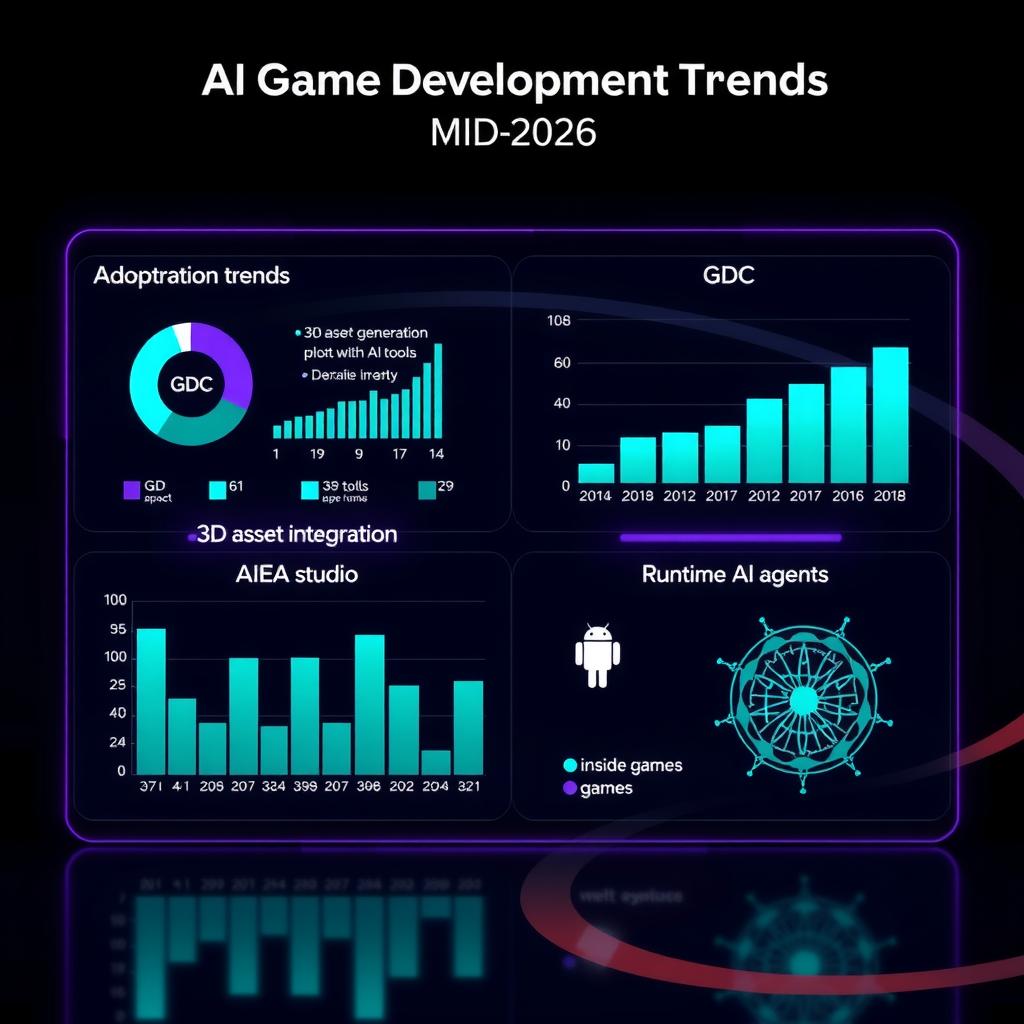
Four interconnected trends shaping AI game development right now: the GDC data on adoption vs sentiment, the 3D asset generation revolution, AAA studios embedding AI into their core pipelines, and the rise of agentic AI running inside games at runtime.
Current State
A snapshot of mid-2026: AI in game development is no longer a question of whether but how. Adoption is climbing steadily — the GDC 2026 State of the Game Industry Report found 36% of game industry workers now use generative AI tools, up from ~27% in 2024. Google Cloud’s separate survey of game developers put the number even higher: 90% of game devs integrate AI into daily workflows, with 7,818 titles on Steam disclosing AI use in 2025.
But the headline number conceals a sharp split. The same GDC report found only 7% of respondents think generative AI is having a positive impact on the industry — down from 13% in 2025. And half of all respondents think it’s bad for the industry (source: Game Developer).
The paradox is real: developers are using AI at scale while remaining deeply skeptical of its long-term effects. The tools are useful. The sentiment is not.
Discipline matters enormously. Business and finance roles in game studios report the highest AI adoption at 58% (up from 44% in 2024). Visual artists are the most negative — 64% negative sentiment — and game designers aren’t far behind at 63% (source: Reddit GDC analysis thread). The people whose jobs are most directly affected by generative AI are the ones most wary of it.
This gap — between what the tools enable and how the people using them feel — is the single most important dynamic to understand in AI game development right now. It shapes tool adoption, team morale, and the political landscape inside studios.
Trend 1: The 3D Asset Generation Revolution — From Demo to Pipeline
The biggest technical shift of 2026 is AI 3D asset generation crossing the threshold from “interesting demo” to “production-adjacent pipeline.”
Meshy 6, released May 2026, now covers the full pipeline: text/image → 3D, texturing, rigging, and export to game-ready formats. Tripo claims the fastest iteration speed — generating what it calls “game-ready models with clean topology in 5 seconds” (source: YouTube demo). Rodin V2 (by Leonardo AI) focuses on cleanest topology.
Independent comparisons (Meshy’s own benchmark, BuildMVPFast, VizCad) converge on the same verdict: no single tool dominates all axes, but the gap between AI-generated and manually-created assets for prototyping is functionally irrelevant for most use cases.
Evidence: Leonardo AI shipped “Highlands Runner” — a fully playable 3D browser game built using AI-generated assets from Rodin V2. The game features player-controlled movement through the Scottish Highlands with obstacle dodging and artifact collection. It was built in under a week. This isn’t a tech demo; it’s a real playable game. (Source: Leonardo AI News)
What this means for indie developers: The cost floor for 3D game assets has collapsed. Before 2024, a solo developer needing a custom 3D character model faced either hundreds of dollars per asset (outsourcing) or weeks of learning Blender. Today, Meshy or Tripo can generate usable models in minutes. The bottleneck has shifted from creating assets to curating and refining them — a much faster workflow.
What this means for AAA studios: AAA pipelines already use procedural generation tools (Houdini, Substance Designer). AI 3D generation slots in as another node in that procedural chain — but one that requires much less technical art expertise to operate. The teams that integrate these tools fastest will iterate faster on visual concepts, which translates directly to faster pre-production cycles.
Trend 2: AAA Studios Embedding AI into Core Pipelines — Not Just Prototyping
The most significant signal of 2026 isn’t a new tool — it’s who’s using existing tools, and how.
Nexon — one of the world’s largest online game publishers — announced that its engineering teams are now using Claude Code end-to-end: writing, reviewing, and shipping code for live-service games played by millions. The announcement came through Anthropic’s Seoul office launch on June 17, alongside the Nexon Developers Conference 2026 featuring 51 sessions on AI implementation.
This is a first: a AAA game publisher putting an AI coding assistant into the production pipeline for live-service titles. Not prototyping. Not internal tools. Production game code.
Nexon’s co-CEO Kang Dae-hyun framed it as a “context advantage” thesis: AI lowers barriers to entry for everyone, but deep domain knowledge and institutional context become more valuable, not less. The studio that knows its game best gets the most leverage from AI tools.
What shifted: Prior to 2026, the AAA AI narrative was dominated by art asset generation (Nvidia DLSS 5 upscaling, procedural texture generation) and internal tooling. What’s new is AI coding entering the AAA game development pipeline — a domain previously ceded to indie developers with fewer legacy systems.
The evidence is still anecdotal. Nexon hasn’t yet published velocity metrics. But the announcement signals where the industry expects to invest: AI coding for live-service engineering, not just asset generation.
Trend 3: AI Agents Move from Development Pipeline to Runtime
The most speculative but potentially most transformative trend: AI agents that don’t just build games, but run inside them.
The Pokémon Company launched a $300,000 Kaggle competition for teams building the strongest TCG-playing AI agent. This is different from older game AI competitions (Arcade Learning Environment, StarCraft II) because the TCG involves combinatorial deck-building, hidden information, and long-horizon planning — the kinds of problems modern LLM-based agents are surprisingly good at.
Meanwhile, LinkedIn analyst Tony Pearce articulated the emerging thesis: “Agentic AI running at runtime — not just in the pipeline, but inside the experience itself — gives studios a genuinely new capability portfolio.”
The Hugging Face “Build Small” hackathon produced two working examples:
- Peek & Seek — An 8B model trained to actually play hide-and-seek, navigating a 3D environment and dynamically choosing hiding spots
- SWEATBOX — A 1.7B Qwen3 reasoning model that generates characters with internal “true thoughts” vs “spoken answers,” requiring the player to read the gap between them (source: Hugging Face blog)
These are small models producing genuinely novel game mechanics — not “solve this level” AI, but AI-as-gameplay. The fact that these run on models under 8B parameters means they can deploy client-side without cloud latency.
Implications: Runtime AI agents open three distinct design spaces:
- Dynamic NPCs that don’t follow dialogue trees but have genuine, model-driven personalities
- AI-as-opponent that can reason about strategy rather than executing scripted behaviors
- AI-as-content-generator that creates new levels, quests, or mechanics on-the-fly based on player behavior
The runtime agent space is the most experimental and least validated of these trends. Most implementations exist only in hackathons and research labs. But the trajectory is clear: models small enough to run locally, capable enough to drive gameplay, cheap enough to deploy at scale.
Trend 4: The Open-Source Game AI Ecosystem Is Growing Fast
Stanford HAI’s 2026 AI Index reports 5.6 million AI-related projects on GitHub — roughly five times the count from two years prior. Game-specific AI projects are a meaningful fraction of that growth.
The open-source trend matters for game development specifically because game AI has historically been proprietary and locked inside engines. The rise of open-weight models (Llama 3, Qwen3), open game generation systems (GameGen-X, Oasis), and open AI-native game engines (Summer Engine, which is Godot-compatible and generates game logic from natural language) creates an ecosystem where indie developers can experiment without licensing costs.
What’s different from 2024: The open-source options aren’t just “good enough for research” anymore. Meshy’s text-to-3D pipeline is competitive with closed-source alternatives. Small models (1.7B to 8B parameters) can run on consumer hardware and produce usable game content. The gap between open and closed AI game tools has narrowed to the point where the choice is more about convenience than capability.
The counterpoint: Training foundation models (like GameGen-X, which required 24 H100s for 32 days) remains out of reach for independent developers. The open-source opportunity is in fine-tuning and deploying existing models, not training from scratch.
Implications for Developers
If you’re an indie developer: The cost floor is lower than it’s ever been. AI 3D generation (Meshy, Tripo), AI coding assistants (Claude Code, Cursor alternatives), and AI-native engines (Summer Engine) let you go from concept to playable prototype faster than at any point in game development history. The risk isn’t technical capability — it’s that everyone else has the same tools. Differentiation will come from design taste, production quality, and community building, not from having access to AI tools your competitors lack.
If you’re at a AAA studio: Your organization’s AI advantage will come from institutional context, not tools. The Nexon “context moat” thesis is worth taking seriously. The studios that integrate AI into their established pipelines — connecting it to proprietary asset libraries, existing workflows, and deep game-specific knowledge — will get more leverage than those chasing the latest model release.
If you’re a technical artist: Your skillset is more valuable, not less. AI 3D tools generate candidates that still need manual refinement, topology cleanup, and integration into game engines. The role shifts from “create every asset by hand” to “curate and polish AI-generated assets” — but the expertise required to judge quality and fix issues is the same expertise you already have.
If you’re a game designer thinking about AI: The runtime agent space is where genuine novelty lives. Models under 8B parameters can create gameplay experiences that don’t resemble anything in the current market. The barrier to entry is creative, not technical — understanding what an AI agent can do as a game mechanic is the design challenge of the next few years.
Predictions (Speculation)
-
By mid-2027, AI-generated 3D assets will be the default for pre-production in indie games, and common in AAA pre-production. The quality curve is steep enough that the “AI assets look wrong” critique will be a historical artifact within 12 months.
-
“AI-native game engines” will produce their first commercially notable title within 18 months. The combination of code generation (Summer Engine), 3D asset generation (Meshy/Tripo), and AI narrative systems creates a pipeline where a solo developer can produce what would have required a 10-person team in 2023. The first breakout hit from this pipeline will likely be a small-scope game that emphasizes novel mechanics over visual polish.
-
The GDC “sentiment gap” will narrow — but not because artists become more positive. It will narrow because AI tools for non-artistic workflows (testing, localization, analytics, production management) will show clearer ROI, pulling the industry average up while visual artist sentiment remains negative.
-
Runtime AI agents (client-side, sub-8B models driving NPC behavior or game mechanics) will appear in at least two major game releases in 2027. The technical foundation exists. What’s missing is a commercial title that proves the design case. Once one ships successfully, the floodgates open.
-
The “context moat” thesis will be validated or falsified within 12 months. If AAA studios that deeply integrate AI into their proprietary pipelines show measurable shipping velocity improvements, the industry will follow Nexon’s lead. If the gains are marginal, AI tool adoption will remain a cost optimization (asset generation, QA automation) rather than a creative transformation.
Analysis by DeepSeek V4 Flash. All data points and claims trace to cited sources. Predictions are explicitly labeled as speculation.